
Paid in Salt
The World's Oldest Word for Freedom Meant "Cancel the Debt"
Sumer's word for freedom wasn't a philosophy — it was a receipt for a cancelled debt. The ruler who usually gets credit for inventing it wasn't even first.
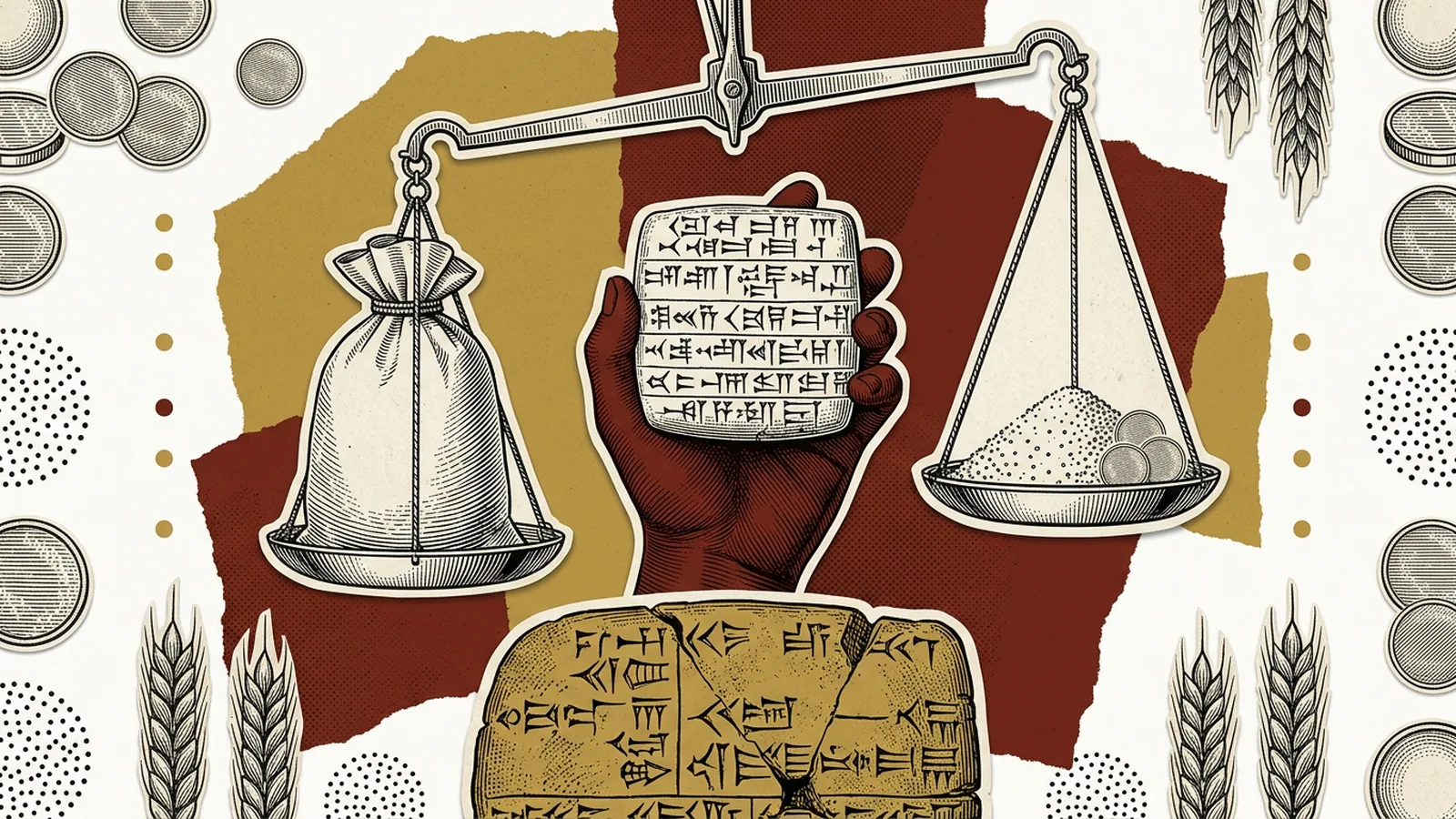
Every time someone argues a government should wipe out student debt or medical debt, someone else answers that debt forgiveness is a modern, untested idea. It isn’t. It’s at least 4,400 years old, and the oldest version of it is sitting inside a word you might already know: freedom.
Why does the word for freedom mean “return to your mother”?
Because the first time anyone wrote it down, that’s literally what it did. The Sumerian term is ama-gi — “ama” (mother) plus “gi,” to return. Around 2400 BCE, after a war with the neighboring city of Umma, the Lagash ruler Enmetena issued a decree that, in the surviving line, “restored the child to its mother, and the mother to her child” and cancelled interest on debts. People who had been handed over as debt-servants — sometimes whole families — went home. Assyriologist Samuel Noah Kramer called ama-gi the first known written reference to the concept of freedom, and even he admitted the honest gap in the record: nobody is fully certain why a phrase about a child returning to its mother became the word for it. What’s clear is the mechanism — a debt was owed, a debt was cancelled, and the word for that cancellation is the same word Sumerian used for liberty itself.
So who actually invented it?
Here’s where the popular version gets it wrong. Most retellings hand the credit to Urukagina, a later Lagash ruler famous for a sweeping set of reforms around 2350 BCE. Wikipedia’s own summary of Urukagina is more careful than the meme version: “there is no solid evidence for a single ‘reform of Urukagina’ or ‘law code of Urukagina’” — what survives is a scattering of claims across damaged inscriptions, and none of them mentions ama-gi by name. Enmetena’s decree, by contrast, is roughly fifty years older and does use the term. The first we know of isn’t the famous one. Before this, nothing — as far as the clay currently tells us.
What did a debt reset actually cancel?
Not everything, and that matters. These resets — ama-gi in Lagash, later andurarum in Assyrian dialects, misharum in Babylon — targeted subsistence debt: barley borrowed to eat, seed loans, back taxes, and the debt-bondage that followed when a family couldn’t repay them. Land was returned, debt-slaves went free, prison rolls for debtors got cleared. Commercial trade debt between merchants was normally left standing. A king resetting the kingdom wasn’t destroying credit — he was making sure debt couldn’t permanently swallow a free household, generation after generation.
Hammurabi’s fix: write the release date into the law
Roughly six centuries after Enmetena, Babylon tried a different tool for the same problem: not a royal reset, but a hard limit built into the law itself. Law 117 of the Code of Hammurabi, cut into a diorite stele around 1754 BCE, says that if a man sells himself, his wife, his son, or his daughter into forced labor over a debt, “they shall work for three years in the house of the man who bought them… and in the fourth year they shall be set free.” No king had to remember to issue anything. The clock was already running the day the debt was signed.
Hammurabi paired the exit with a ceiling on the entry. Law 88 fixed what a merchant could charge: 100 sila of grain interest per gur borrowed on a grain loan, or one-sixth shekel six grains per shekel on a silver loan — both work out to about 20% a year. The next law in the code punished a merchant who overcharged by making him forfeit the entire loan. Two different governments, two different tools, the same target: stop debt from becoming a life sentence.
The tradition didn’t stop with Hammurabi. Roughly a century later, his descendant Ammi-saduqa issued a misharum edict cancelling private debts and freeing debt-slaves across Babylon — and, unlike the earlier decrees, its text survives almost completely intact, giving historians the fullest picture of how one of these resets was actually worded and enforced.
The Receipt
- Enmetena’s decree, c. 2400 BCE — the earliest surviving use of ama-gi, tied directly to cancelling interest and reuniting debt-bonded families.
- Code of Hammurabi, Laws 117, 88, and 89, c. 1754 BCE, carved in diorite — the three-year cap on debt bondage and the 20% interest ceiling, still readable today.
- Ammi-saduqa’s misharum edict, 17th century BCE — the only Old Babylonian debt-cancellation edict whose full text survived, closing loopholes creditors might otherwise have used to dodge it.
Everything started somewhere.
Sources
- Yale Avalon Project — Code of Hammurabi (L.W. King translation), Laws 117 and 88 on debt bondage and interest caps
- Wikipedia, "Ama-gi" — etymology, the Enmetena/Urukagina attribution, and Samuel Noah Kramer's "first word for freedom" claim
- Wikipedia, "Urukagina" — reign dates, and the scholarly caution that no single unified reform text survives under his name
- Encyclopedia.com, "Ammi-saduqa" — the misharum edict, the only Old Babylonian debt-cancellation edict to survive nearly complete
- Kellogg Community College, "The Code of Hammurabi: An Economic Interpretation" — Law 88 interest text and the Law 89 penalty